ROYBOOK
Building brands to grow understanding their mission and vision and the purpose:
Why does the brand exist?
Vision: What future the brands want to create?
Mission: Creating and analyzing that future
Values: About the company and the process they deliver
At my core, I am a UX strategist who believes that a highly effective product strategy requires insight into the intersection of design, business, technology, and the user. My strengths encompass defining the product vision, crafting compelling stories, and designing seamless, human-centered experiences across complex ecosystems. I enjoy interfacing with start-ups and non-profits), internal executives, and product teams to bring innovative ideas to life. I thrive on building multidisciplinary teams, solving business problems, and envisioning experiences that delight users. I fundamentally believe that design can improve people’s lives, transform companies, and change culture.
Verticals
E-commerce, healthcare, education, publishing
Specialties
UX strategy, innovation consulting, experience design, user experience, service design, design thinking, visual design, interaction design, user research, prototyping, branding, storytelling, scenario use case development, convergent design across digital, physical and human touchpoints, workshop facilitation, leadership + management, mentoring, business development, proposal writing, client pitches, client relations.

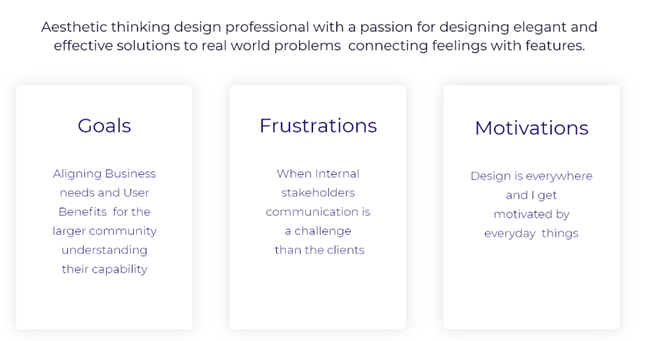
A problem-solver, cognitive with a Visual Eye having an understanding of design principles following the Agile Method.
An agile practice that promotes continuous iteration of development and testing throughout the software development life cycle of the project. Both development and testing activities are concurrent, unlike the Waterfall model.

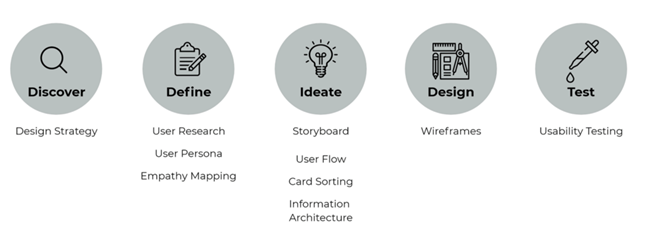
Discover — Building Strategy
Method: Why, What, How, Who, Where
Empathize- Learning about the user demographic
(Understanding Problem/Research)
We are trying to solve the discovery of larger group or community and their problem and how we can solve as per their capability ( users goal and objective )
Define- Define the Scope of Work
Research User Demographics and Business Demographics
( Meet, Talk, Observe.) (Defining the problem)(WHY we need this?) Analysis- Interviews ( Mind Mapping), to remove our assumptions., Functions, Competitive analysis — Evaluating existing task flows, Task Analysis- Proposing new task flows. Need to define technology.
What is Demographics and where we use it? — Qualitative Questionnaires, User Persona Study of 2 Different frequent and Odd
— Empathy mapping on odd and Frequent characters (Think and Feel)( Say and Do)( Hear ) (See )
— Pain and Gain
Qualitative method?
- which is change and observe through tangible field study on everyday activity. it's an iterative process
Quantitative method?
- Which can be counted or measured by asking a question to focus group with getting the task time by methods like card sorting
— 20 users, Tree testing- 50–100, eye tracker 40 users
Ideate — Creating the structure through storyboarding and creating User journey with odd and frequent Persona study, User Flow, Card Sorting, and Information Architecture.
What — (generating ideas), solution- how will the pieces fit together, Draw sketch ( Low-Fi ), visualize- Creation of Information Architecture — Defining Navigation ( Card sorting )Evaluating current and proposing a new architecture
- User Journey through (Entice, Enter, Engage, Exit and Extend)
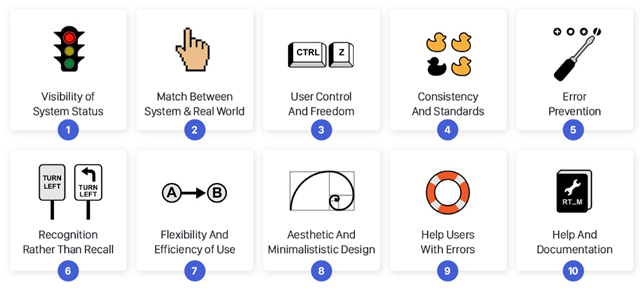
10- Usability Heuristic Principles
Usability is an important quality indicator of interactive IT products/systems. It refers to the degree to which products are effective, easy to use, easy to learn, efficient, fewer errors, and satisfying to users. Usability is mainly about the functional part of the product. In a word, “Don’t make me think”. Remember, stop making usability mistakes as they can kill your website conversions.
https://medium.muz.li/10-tips-on-how-to-conduct-a-perfect-heuristic-evaluation-ae5f8f4b3257
https://www.youtube.com/watch?v=iIQVRzatb50&list=PLJOFJ3Ok_idtb2YeifXlG1-TYoMBLoG6I&index=10

Design and Implement — ( Low and High Fidelity )
Activities: Draw paper Sketches, whiteboard flows, Low-Fi Wireframes to share ideas with stakeholders using 3 design principles ( Fitts law which is a place of elements, Mimicry which is a reference from something from real-world and aesthetic is to make it visually appealing
Heuristic Evaluations
Gestalt principles
- Implement building functionality by the tech team.
Activities: Implement back-end functionality
Outcomes: Developed UI with complete functionality and experience following the designed theme and style
- Evaluate: Validating User Flows
- Inter action: ongoing action between the parties. relationship with any humans or object
Activities: Validating user flows
Outcomes: User Feedback, UI Audits, Improvement areas
Few Trending Fonts:
http://www.typevibes.com/
Awareness of trending pairing fonts
serif ( With End Strokes- Times new roman): Rockwell, Sabon, Jura, Brela, Cormorant, Crimson text
sanserif ( Without Strokes- Arial): DIN 1451, Proxima Nova, Montserrat, Nunito, Ui Sans, Open sans, Segoe UI, Moon, Coves, Big john, Slim John, Baron, Aqua Grotesque, Dense
To pair the fonts We need to take care of the Typefaces, Contrast with Serf and Sanserif,
Likes:
Bebas neu is bold with Montserrat.
Open sans extra bold / Cooper Hewitt
Raleway/ Roboto
Sefon/babus Neue
Anton/Opensans light
- For Kiosk displays, any sans serif font(IBM Plex Sans, Roboto, Open Sans, Cairo Black, Rajdhani, etc)
Where do i take colors for my designs?
I Prefer something from real world.
- www.paleton.com
- https://htmlcolorcodes.com/color-picker/
- Found an article you may be interested in:
https://digitalsynopsis.com/design/2019-color-trends-worlds-most-popular-colors/
Test
GA, AB testing, Use Case scenarios, task-based, Usability testing
- Where are your users mainly coming from?
- Which section do the users stay the longest?
- Which areas on your page are getting the most clicks?
- Which parts can be optimized and which can be ignored?
- Manual Testing by observing the user by giving a task and tracking the duration
- Heat map by few tools like crazy egg similar to GS
- Eye-tracking — WebEyeMapper and WebLogger
Tools Used:
Microsoft invisio and Flow map, XMind, Mindomo, etc.
Sketch, Figma, XD, Balsamiq, Invision, Zeplin etc.
Upgraded with Adobe Suite-Illustrator, Photoshop, Affinity, Max, Maya, etc.
Advanced animations, be it via CSS, JS, video or 3D Browser Engines, After effect
Testing Tools: Crazyeggs, Manual testing,
What are the design best practices?
-Words, Declutterness, clarity
-Validation
-Testing, Being humble, Delight users.
-Words: People don’t read
-Write with your heart and edit with your brain
-Consistency is the key
-Sorting the content on priority
-perfection is achieved when there is nothing left to take away
-Reduce the user's effort
-100 clear screen is always better than 1 cluttered
-Smooth user journey without any confusion
-Ego kills design, It stops Learning and is the biggest enemy of design
-Never be satisfied, become mindful and honest
-it is not for us it is for users
-Whitespaces
-connecting feelings with features
What makes any online sale a true success:#
- 50% — product quality.
— 5% — brand name (this finding fully disrupts the myth that the more solid and famous the brand, the more sales it makes online)
— 15% — interaction with the customer (e.g. engagement in social media, tech support, etc)
-10% — promotion
— 20% = user currency (7%) + translation / localization (5%) + payment methods (5%) + user support (3%)
Agile Methods:
- Getting the Backlogs and converting that to sprint
- Daily stand up with the team on the progress
Don’t Make Me Think: 20 Wise Thoughts about Usability — Designing for Emotion
-If something requires a large investment of time — or looks like it will — it’s less likely to be used.
-Making every page or screen self-evident is like having good lighting in a store: it just makes everything seem better.


Comments
Post a Comment